
A story, our way: reading together beyond the words
Pictures to explore, voices to try and room for your child’s ideas: simple ways to enjoy books and stories together.
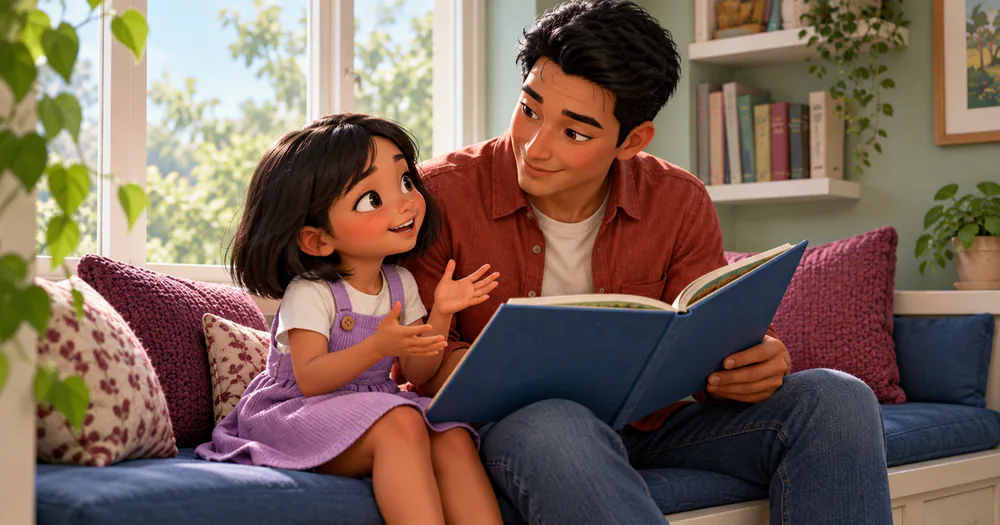
You open a book and begin the first sentence. Your child points to a tiny cat in the corner, turns back a page or asks why the moon is wearing a hat. Suddenly, you are following a story inside the story.
You can make room for those detours. Reading together might mean listening to the words, looking closely at a picture or deciding how a sleepy bear sounds.
Here are a few ways to share the moment, including with children who do not read on their own yet.
Let your child choose how to start
Offer a choice between two books, or let your child bring you one. Find a comfortable place where you can both see the pages. Sitting side by side works just as well as having your child on your lap.
You could ask: “Shall we read the words or look at the pictures first?” If your child wants you to start straight away, do that. You can simply open the book and begin.
1. Follow a detail in the picture
Before reading a page, leave a little room to look. You might notice something aloud: “That cat is peeking out of a boot.” Then wait. Your child can answer, point or simply keep looking.
For example:
Your child: “There's another cat!”
You: “Oh, behind the curtain. I hadn't spotted that one.”
You do not need a question for every page. If your child asks you to keep reading, let the story flow. Looking for details is an option, not a task hidden inside the book.
2. Give a character a voice
Try one small change. A slow voice for a sleepy bear. A quick voice for a busy mouse. A whisper for someone sharing a secret. You do not need a show for every character.
You could say: “I wonder how this bear says good morning.” Try a long, yawning “Good mooorning”. Then let your child try their own version, if they want to.
If funny voices interrupt the story or your child prefers your usual voice, switch back. You can read in your usual voice throughout.
3. Leave space for an interruption
A picture of a red bus might remind your child of yesterday's journey. You can pause to talk about the memory, then return to the story.
Your child: “We went on a bus!”
You: “We did. You sat beside the window. Shall we see where this one goes?”
Sometimes you will spend longer talking about a page than reading it. You can put a finger where you stopped and return when you are ready.
If you would like to finish a sentence first, say so gently: “I'll read this bit, then I want to hear about your bus.”
4. Read the favourite again
When your child chooses the same book again, you can read it in the same familiar way. There is no need to make every rereading into a new activity.
If your child enjoys joining in, pause before a familiar line and leave room for their words, sound or gesture. If they stay quiet, carry on without asking them to prove they remember.
For example: a character knocks at a door on several pages. You can tap softly on your knee each time. Your child might join you, choose a different knock or simply listen.
And if you would like a change, offer one: “Let's read this one, then shall we choose something else?” Your enjoyment matters too.
5. Tell a story without reading words
With a wordless picture book, you can take turns describing what seems to be happening. You can also invent a new story from an illustration in another book, making it clear that this is your version.
You: “In our story, this rabbit is carrying a very important parcel. What's inside?”
Your child: “A birthday cake for a dragon!”
You: “Then we'd better find the dragon before the icing melts.”
If your child wants to tell the whole story, listen. If they offer only one idea, you can build on it. There is no need to turn the game into a lesson about beginning, middle and end.
When you do not reach the last page
Your child may close the book after a few pages or want to skip to a favourite picture. You can say: “We'll leave it here for now.” A bookmark can keep your place if you both want to return.
If they would rather listen without talking, let them. The invitations above are choices, not steps to work through every time you open a book.
Let the story stay with you
Later, you might use the bear's sleepy voice while putting a toy to bed or wonder what the dragon thought of the cake. Follow the idea if it is still fun; you do not need to plan an activity after reading.
A shared reading moment can end with a laugh, a question or simply the book closing. You have spent a little time inside a story together, in your own way.
More to explore
One walk, little discoveries: play and curiosity outdoors
Sounds, shadows and stories along the way: simple ideas for exploring together, even on a familiar walk.
Read article
Play starts with a box: 7 ideas using things you already have at home
A cardboard box, a few sheets of paper and a favourite soft toy. Sometimes, that is all you need to begin a new game together.
Read article
“I can’t do it!”: helping children when something feels hard
A puzzle, a zip, a drawing: everyday ways to offer encouragement, useful help and room for a break when your child feels stuck.
Read article
From counting words to quantities: making sense of numbers
Saying the number sequence is different from knowing how many. Explore small quantities through toys, place settings and everyday conversations.
Read article