
“I can’t do it!”: helping children when something feels hard
A puzzle, a zip, a drawing: everyday ways to offer encouragement, useful help and room for a break when your child feels stuck.
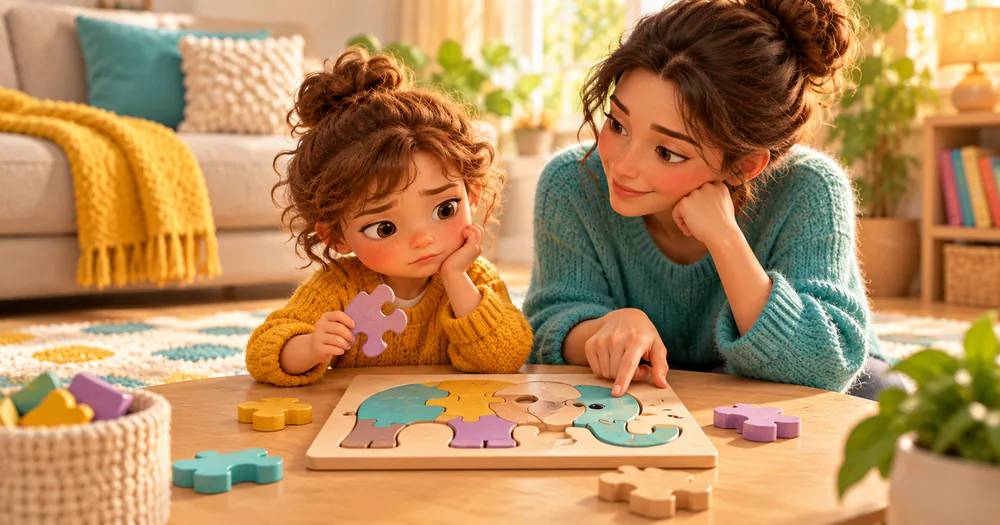
The puzzle piece will not fit. The zip keeps slipping. The drawing looks different from the picture in your child's head. Then comes the shout: “I can't do it!”
It is tempting to answer “Yes, you can!” or finish the job ourselves. You could start by finding out what your child needs right now: company, a small hint, help with one awkward step, or a break.
Start with the feeling, before the solution
When your child is very upset, keep your words simple: “That piece isn't going where you want it. You're upset. I'm here.” Leave room for them to tell you if you have misunderstood.
The American Academy of Pediatrics recommends helping a stressed child feel calm and understood before moving into problem-solving. Naming feelings and using a calm voice are among its suggestions. Read the AAP guidance.
You do not need to turn the moment into a long conversation. Sit nearby, offer company and wait. A child who does not want a hug can still have your support.
Offer help with the next step
“Try harder” does not tell a child what to change. A more useful offer might be: “Shall we look at the shape of this corner?”
Experts at Harvard call this kind of help scaffolding. You give as much help as is needed, then less and less as your child learns to do it alone. Read the explanation.
At home, you could ask before stepping in, show one small action, then leave the next move to your child.
If that is still too difficult, offer more help or simplify the activity. You do not have to stop helping after a set number of tries.
When a puzzle piece will not fit
Your child: “It doesn't work!”
You: “Want a hint, or shall we try it together?”
If they want a hint, point out one detail: “This side is straight. Where is there a straight edge?” Give them time to look. If they want to do it together, help turn the piece and let them choose where to place it.
When getting dressed becomes a struggle
Your child: “You do it!”
You: “I'll fasten the bottom of the zip. Would you like to pull it up?”
On a rushed morning, you can also say: “I'll help you get ready today. We can practise when we have more time.” You do not have to turn every trip out into a lesson.
When the drawing looks “wrong”
Your child: “My dog looks silly!”
You: “It isn't how you wanted it to look. Which part would you like to change?”
Offer a spare sheet, draw alongside them if invited, or let the drawing stay unfinished. You do not have to persuade them to like it.
Notice what they actually did
Make encouragement specific: “You turned the piece and checked again.” Or: “You asked me to hold the paper while you folded it.” Just describe what happened. There is no need to applaud every move.
A 2013 study followed 53 children. Some often heard praise for their effort between the ages of one and three.
At seven or eight, these children were more likely to believe you can get better at things. The study shows a link, not a sure cause. Gunderson and colleagues, 2013.
For everyday conversation, try noticing a choice, a changed approach or a request for help. Use words that feel natural to you. You do not need to memorise a script.
Leave room for a break
Offer a clear choice: “Shall we put this aside, or do one part together?” If your child wants to stop an optional game, you can stop. You can return to the game later, but you do not have to.
If blocks start flying, keep the boundary simple: “I won't let you throw blocks at people. I'll put these here.” You can acknowledge disappointment and still keep people safe.
And when you lose patience?
You may hear yourself say “It's easy!” before you have time to think. You can return to the moment: “I said that too quickly. It feels difficult to you. Let's see which part is getting stuck.”
There does not have to be a finished puzzle or a perfect drawing at the end. Today, the useful next step might simply be your child saying: “Can you help me with this bit?”
Sources and further reading
The dialogues are illustrative examples written for this article, not quotations from the sources or tested scripts.
More to explore

A story, our way: reading together beyond the words
Pictures to explore, voices to try and room for your child’s ideas: simple ways to enjoy books and stories together.
Read article
From counting words to quantities: making sense of numbers
Saying the number sequence is different from knowing how many. Explore small quantities through toys, place settings and everyday conversations.
Read article
What do children learn from puzzles? Physical and digital play explained
What happens when a child compares, turns and fits puzzle pieces? Research explained simply, a physical–digital comparison and practical ideas for playing together.
Read article
Letters, sounds and pictures: exploring the alphabet together
A letter has a shape, a name and sounds in words. Explore those connections with familiar pictures, simple examples and research explained clearly.
Read article