
From counting words to quantities: making sense of numbers
Saying the number sequence is different from knowing how many. Explore small quantities through toys, place settings and everyday conversations.
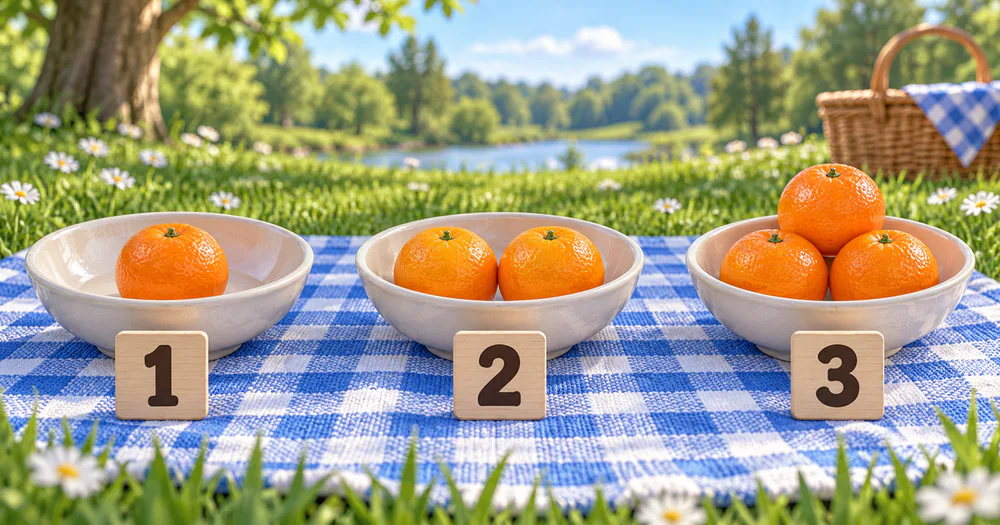
Your child can say “one, two, three, four, five”, but when you ask for three spoons, they bring a handful. The number sequence and the amount requested are different things to work out.
Early number play can make that connection visible. A small group of toys, a few place settings or a picture card gives a number something concrete to refer to. You do not need to begin with written sums.
Saying numbers, recognising numerals and counting objects
Take the number three. Your child might recognise the numeral 3. They might say “three” in a counting rhyme.
They might give a spoon to each of three people. These skills are linked, but being able to do one does not mean they can do them all.
When counting objects, we say one number word for each object and count each object once. The final number tells us how many are in the whole group.
This is called the cardinal principle. You can explain it without the technical term: “One, two, three. Three spoons altogether.” This distinction is also set out in the NCETM guidance on cardinality and counting.
What do the studies and guidance tell us?
A study by Susan Levine and her colleagues followed 44 children. Parents who talked about numbers more often when their children were between one and two and a half had children who later understood “how many” better.
This is a link that was observed, not a recipe with a fixed number of words. The study on parent number talk.
A US guide on early maths (from the Institute of Education Sciences) recommends learning numbers step by step. At home, that means starting from what your child can already do.
There is no need to pick a bigger number just because it looks harder. Teaching Math to Young Children.
The examples below are everyday suggestions, not a tested programme or a timetable for your child's progress.
Start with a small, visible group
Choose a few large objects that are easy to handle and keep apart. Three toy animals are enough for a conversation. A smaller set can be useful if the child is still exploring how to touch one item for each number word.
Place them where you can both see them. If you use food, follow your usual age-appropriate preparation and supervision; the counting activity does not require eating it. Large toys or spoons work just as well.
Five ways to explore numbers at home
1. Move one object for each number
Put three toy cars on one side of a mat. Move each car to the other side as you count: “One, two, three. Three cars.” Moving them creates a visible distinction between those already counted and those still waiting.
If your child says two numbers while moving one car, slow down and show the action again. You can take turns: you move, they count, then swap. There is no need to restart the whole activity after every slip.
2. Prepare a small order
Play a delivery game: “Could the toy rabbit have two blocks?” Let your child choose the blocks, then count the delivered group together if needed. Asking for a group adds a question that a counting rhyme does not: when should I stop?
If two is comfortable, try another small amount. If it is not, give one object together and describe what you did.
3. Set one place for each person
Put out a placemat for each person who will eat. Invite your child to give each place one spoon. Then look together: “Does everyone have one? Is any place missing a spoon?”
This lets you explore one-to-one matching even before your child wants to name the total. Later, count the places and the spoons and compare the amounts.
4. Connect the quantity to the written numeral
After counting three toys, place a card with 3 beside them. Say: “This is how we write three.” On another day, the same card could sit beside three cups or three large blocks.
Keep the numeral separate from the objects so you can move it to another group. The aim is for 3 to refer to the amount, not only to one familiar picture.
5. Change the arrangement
Count three blocks in a row. Then move them into a triangle without adding or removing any. Ask, “What changed?” You can explain that you moved them, then count together again.
If your child thinks the spread-out group contains more, explore it rather than treating the answer as a failure. You could bring each block back to its original place and see what remains.
Comparing amounts without making everything a quiz
At a pretend picnic, put two cups beside three toy guests. “Has everyone got a cup?” Let your child notice the empty place or pair one guest with one cup. Then add the missing cup.
There is no need to count every object in the house. Choose moments when the amount matters: enough plates, a requested number of blocks or one more toy passenger. You can make an observation yourself instead of always asking a question.
What should a number game ask the child to do?
A digital activity that asks for the symbol 3 involves recognising a numeral. One that asks the child to give three apples involves creating a quantity. Neither task should be described as proof that the child understands all aspects of three.
Check that the objects are easy to count and that hints do not make every choice for the child. If your child can pick a numeral on screen, try the same number with real objects at home too.
Small observations are useful: your child counts each toy once, stops after the requested amount or notices that someone needs a spoon. They give you a starting point for the next shared activity, without comparing your child with anyone else.
More to explore
“I can’t do it!”: helping children when something feels hard
A puzzle, a zip, a drawing: everyday ways to offer encouragement, useful help and room for a break when your child feels stuck.
Read article
A story, our way: reading together beyond the words
Pictures to explore, voices to try and room for your child’s ideas: simple ways to enjoy books and stories together.
Read article
What do children learn from puzzles? Physical and digital play explained
What happens when a child compares, turns and fits puzzle pieces? Research explained simply, a physical–digital comparison and practical ideas for playing together.
Read article
Letters, sounds and pictures: exploring the alphabet together
A letter has a shape, a name and sounds in words. Explore those connections with familiar pictures, simple examples and research explained clearly.
Read article