
Matching and sorting: what children practise and how to try it at home
Pairs of socks, groups of shapes and objects that belong together: what children practise, what research tells us and simple ideas for home.
You are putting away clean socks when your child finds two with the same stripes. A moment later, they put every small sock together, regardless of its pattern.
Both choices make sense, but they answer different questions: “Which two match?” and “Which ones belong in this group?”
Matching and sorting can happen with toys, pictures or ordinary household objects. The useful part is the relationship the child notices and the rule they use, rather than how quickly everything reaches the right basket.
Matching, associating and sorting: what is the difference?
- Matching: finding two things that share the feature you are looking for, such as identical picture cards.
- Associating: connecting things that go together, such as a paintbrush and a painting. They do not have to look alike.
- Sorting: dividing several objects into groups using a rule, such as putting spoons together and cups together.
Sometimes more than one answer is reasonable. A toy apple might belong with red things, toy food or round objects. If you have not specified a rule, ask your child about their choice before calling it wrong.
What does the child practise?
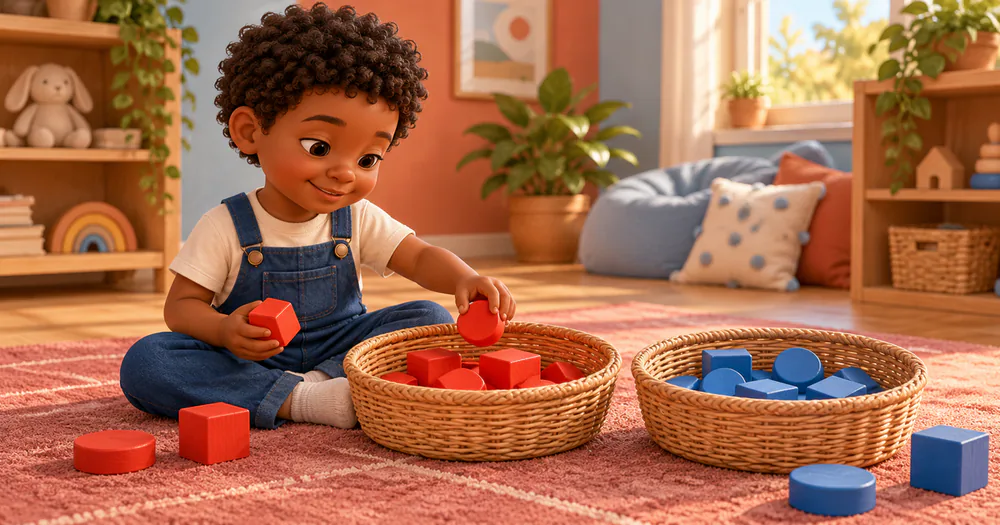
To sort red and blue blocks, a child needs to look at colour, keep that rule in mind and decide where each block belongs.
If the rule changes to circles and squares, colour is no longer the relevant clue. Switching the rule adds a different challenge.
During these activities, children can practise comparing features, recognising similarities and explaining a choice. Handling cards or objects also involves picking them up and placing them. These are opportunities within the activity, not a promise of better intelligence or concentration in every setting.
What do researchers study with sorting tasks?
Researchers use a card game called the Dimensional Change Card Sort. Children sort first by colour, then by shape.
It shows how easily they switch a rule and keep their attention on a goal. It is a way of measuring, not proof that sorting socks trains these skills. Zelazo's description of the task.
In a study with 57 young children, some cards showed a coloured shape. Others showed the shape on a separate coloured background. Children switched the rule more easily with the second kind.
So the way a game looks matters. One hard game does not tell you what a child can do. Diamond, Carlson and Beck's study.
Four ways to try it at home
1. Find the sock partner
Put out two or three pairs with clearly different patterns. Choose one sock and look for its partner together. You could say: “This one has wide stripes. What do you notice about that one?” If the choice is too broad, offer just two possible partners.
Keep the task focused on the matching feature. Two socks can share a colour but have different sizes or patterns. Say what you are looking for rather than expecting your child to guess.
2. Give the toy kitchen two shelves
Use sturdy cups and spoons, or large toy versions. Decide that cups go in one place and spoons in another. Put away one example yourself, then invite your child to choose the next object.
Later, a different rule could be “things we drink from” and “things we stir with”. This adds a conversation about use. Choose objects without sharp edges or small detachable parts.
3. Find things that work together
Set out a shoe, a sock, a piece of paper and a chunky crayon. Ask which things your child might use together. Accept an explanation that makes sense: the shoe and paper could go together if they want to draw around the shoe.
If you have one association in mind, give the context. Ask: “Which of these would you use to draw on this paper?” That is clearer than just “Which one belongs?”
4. Sort the same shapes another way
Use large red and blue circles and squares. Start with one rule and a small number of pieces. Once you have finished, clear the groups and announce the new rule: “We used colour before. Now let's put the circles together.” Demonstrate the first choice.
If your child continues using colour, point to the new example or return to the first game. There is no need to keep switching until they get it right.
How to respond when a choice surprises you
Try three steps: ask, explain and offer another attempt. “What made you put it there?” may reveal that the child has noticed a feature you missed. Then clarify your rule: “You chose the red things. This time we are looking for round things.”
A child can show their thinking by pointing or moving an object; a full spoken explanation is not required. You can also describe what you notice: “You found another cup.”
What about digital matching games?
Look at what the game asks the child to decide. Matching an image to its outline is different from grouping objects by their use. If a hint immediately points to the answer, the child's task is different again.
You can share the screen and discuss a choice, then explore a similar relationship with real objects. Keep physical play available too. Neither a correct tap nor a completed basket, by itself, shows that a child understands every version of a rule.
The aim is a small discovery you can talk about. These look alike. Those work together. And the same object can join a different group when the question changes.
More to explore
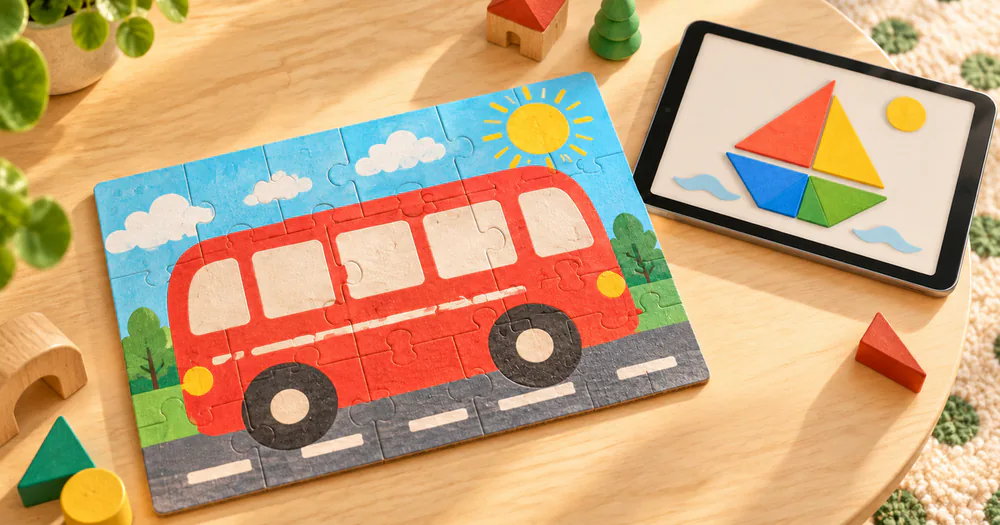
What do children learn from puzzles? Physical and digital play explained
What happens when a child compares, turns and fits puzzle pieces? Research explained simply, a physical–digital comparison and practical ideas for playing together.
Read article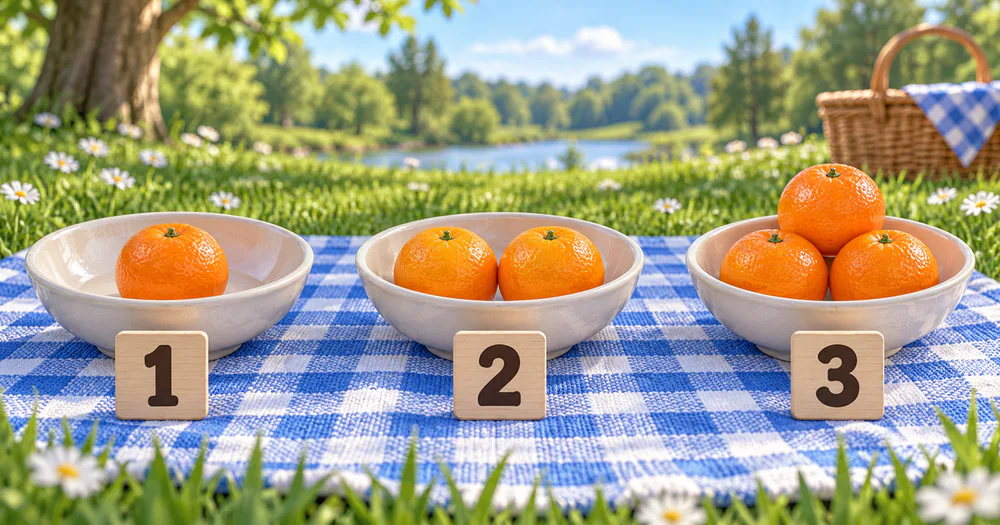
From counting words to quantities: making sense of numbers
Saying the number sequence is different from knowing how many. Explore small quantities through toys, place settings and everyday conversations.
Read article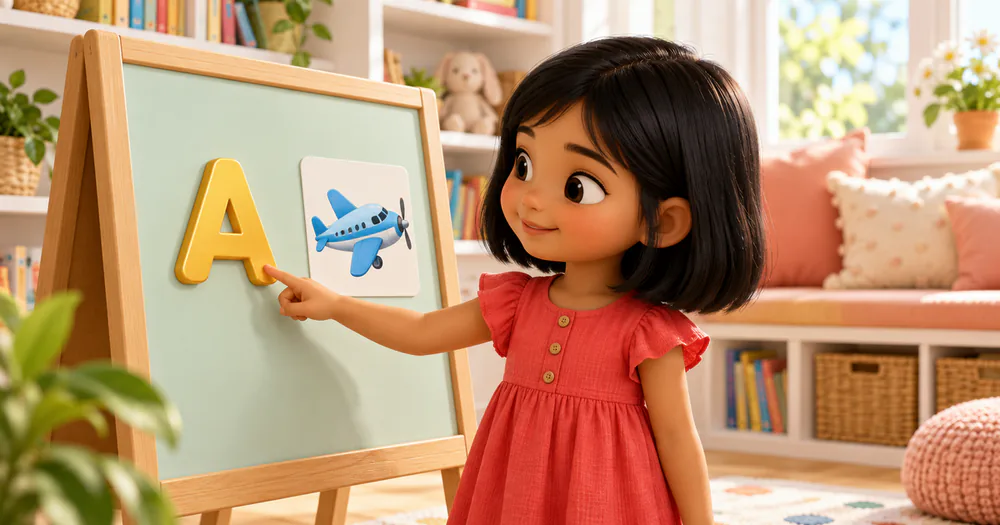
Letters, sounds and pictures: exploring the alphabet together
A letter has a shape, a name and sounds in words. Explore those connections with familiar pictures, simple examples and research explained clearly.
Read article
Play starts with a box: 7 ideas using things you already have at home
A cardboard box, a few sheets of paper and a favourite soft toy. Sometimes, that is all you need to begin a new game together.
Read article