
What do children learn from puzzles? Physical and digital play explained
What happens when a child compares, turns and fits puzzle pieces? Research explained simply, a physical–digital comparison and practical ideas for playing together.
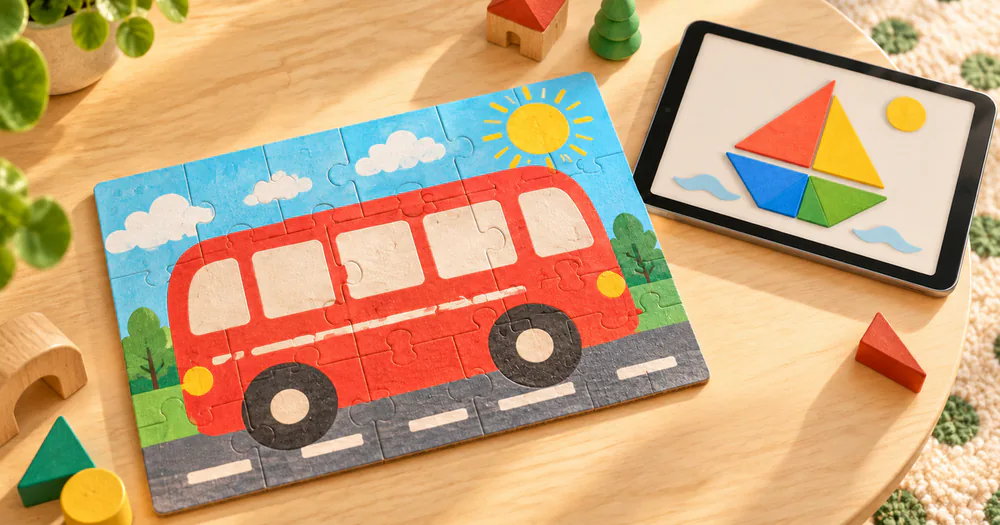
A piece looks as though it belongs beside the cat, but it will not fit. Your child turns it, looks at the picture and tries again. A puzzle gives them something concrete to work out: which pieces belong together, and how?
Whether the pieces are on a table or a screen, it is worth looking at what the child actually does. Choosing, comparing and turning pieces are different tasks from watching a picture assemble itself.
What does a child practise with a puzzle?
Think of a simple picture of a bus. One piece shows half a wheel. Finding the other half involves looking at a detail and connecting it with the whole picture. Turning a piece to make the wheel line up involves thinking about its position.
This is part of spatial thinking: understanding shapes, positions and how things fit together. You use it when deciding which way a box will fit on a shelf or how to arrange objects in a drawer.
These are everyday examples of spatial thinking, not proof that completing a puzzle will improve every such task.
A puzzle can also provide opportunities to:
- Compare details: “Both pieces are blue, but only one has part of the window.”
- Try a plan: look for the bus first, or gather pieces with a straight edge.
- Revise an idea: notice that a piece does not fit and try another position.
- Use words for position: above, below, beside, corner and edge.
These describe actions within the activity. They do not mean that puzzles automatically improve general attention, intelligence or school results.
What does the research say?
Researcher Susan Levine and her colleagues followed 53 children. Some played more with puzzles between the ages of two and four.
Later, these children did better when they had to “turn” shapes in their mind. The study found a link; it cannot say for sure that puzzles caused it. Read the study on early puzzle play.
With screen games, it also matters what was measured. A study of 55 three- and four-year-olds found that children who were good with shapes and positions also did better in two tablet games.
That does not mean the games made them better. Read the study on touchscreen spatial games.
Physical or digital puzzles: what is different?
The comparison below concerns how the activities work. It is not a ranking of their effects on development. Digital games vary: some allow rotation, while others only ask children to move pieces into matching outlines.
| Aspect | Physical puzzle | Digital puzzle |
|---|---|---|
| Moving pieces | The child picks up, turns and places an object, feeling its thickness and edges. | The child uses touch or a mouse. Rotation may be manual, automatic or unavailable. |
| Checking a fit | The shape and the picture show whether the pieces join. A piece should not need forcing. | The game may snap a piece into place, return it or show a cue. Check how much the software does for the child. |
| Changing the challenge | You can offer a few pieces from a larger puzzle or complete one section together. | Some games offer different levels, piece counts or hints. Check which options are actually available. |
| Playing together | You can spread pieces out and work side by side. | You can share a screen, talk about a choice and take turns controlling it. |
Moving a finger across glass is not the same hand action as lifting and fitting a wooden piece. Both involve movement, but they offer different physical experiences.
Has research compared the two formats?
Yes. Researchers split 61 three-year-olds from families with fewer resources into three groups by drawing lots. One group built shapes with real pieces, one did the same on a screen and one kept its usual activities.
After five weeks, both practice groups improved more than the third. There was no clear difference between real pieces and the screen. It was a single programme, so we do not know if this holds for every game or if it lasts. Read the physical–digital comparison study.
How to choose a puzzle for your child
Use the product's age and safety guidance as a starting point, then watch how your child gets on. Piece count alone does not describe the challenge: a picture with clear, distinct objects offers different clues from a large area of similar colours.
For a physical puzzle, consider whether your child can handle the pieces comfortably. Keep small pieces away from children who might put them in their mouths. For a digital puzzle, try the controls yourself and check for adverts, purchase prompts and interruptions.
If your family uses digital puzzles, leave room for handling real objects, movement and other activities too. There is no need to introduce a screen just to offer puzzle play.
Five ways to help without taking over
- Look together. “What can you see in the picture?” Point out one feature if your child needs a starting place.
- Leave a choice. “Would you like to build the bus or the tree first?” You do not have to begin with the border.
- Offer one clue. “This piece has part of a wheel.” Pause before giving the next instruction.
- Demonstrate if needed. “I'll turn this piece so the straight side is at the bottom. Would you like to try the next one?”
- Make stopping possible. Save the unfinished puzzle or put it away together. Finishing today does not have to be the goal.
For example, if your child keeps trying the same piece in one place, you could say: “The colour matches.
Let's look at the shape too.” On a screen, you might say the same thing before the child drags the piece. These are suggestions to try, not a script to follow at every move.
What matters beyond the finished picture?
A useful moment might be your child noticing a clue, changing a plan or telling you why they chose a piece. You can acknowledge the action: “You turned it and the window lined up.”
You can also explore a similar idea elsewhere: “Will this box fit if we turn it?” That offers another experience with shape and position.
It is not a test of whether the puzzle has “worked”. Choose a challenge your child can take part in, offer help when needed and keep room for enjoying the picture together.
More to explore
Letters, sounds and pictures: exploring the alphabet together
A letter has a shape, a name and sounds in words. Explore those connections with familiar pictures, simple examples and research explained clearly.
Read article
“I can’t do it!”: helping children when something feels hard
A puzzle, a zip, a drawing: everyday ways to offer encouragement, useful help and room for a break when your child feels stuck.
Read article
One walk, little discoveries: play and curiosity outdoors
Sounds, shadows and stories along the way: simple ideas for exploring together, even on a familiar walk.
Read article
Matching and sorting: what children practise and how to try it at home
Pairs of socks, groups of shapes and objects that belong together: what children practise, what research tells us and simple ideas for home.
Read article